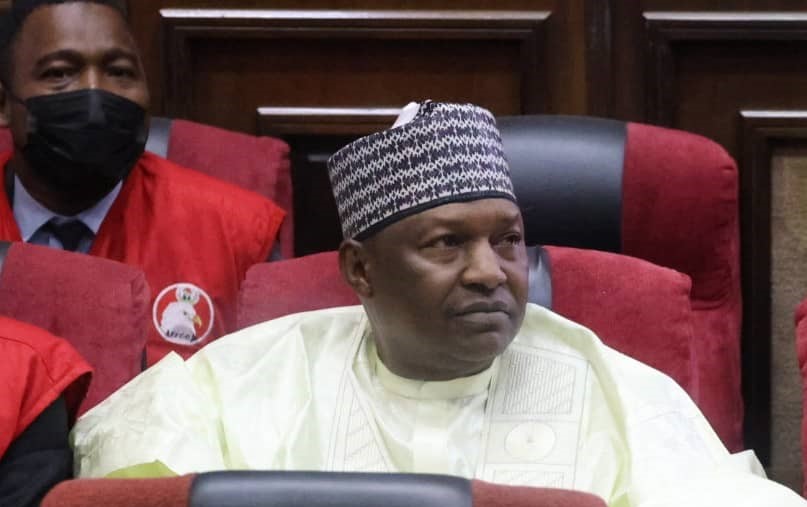
The Economic and Financial Crimes Commission (EFCC) on Tuesday arraigned a former Attorney-General of the Federation and Minister of Justice, Abubakar Malami (SAN), alongside his wife, Hajia Bashir Asabe, and their son, Abubakar Abdulaziz Malami, before the Federal High Court in Abuja over alleged money laundering involving N8.7 billion.
The defendants were brought before Justice Emeka Nwite of the Federal High Court, Maitama, Abuja, on a 16-count charge bordering on conspiracy, procuring, disguising, concealing and laundering proceeds of unlawful activities, contrary to the provisions of the Money Laundering (Prevention and Prohibition) Act, 2022.

At the commencement of proceedings, prosecution counsel, Ekele Iheanacho (SAN), told the court that the matter was for arraignment and prayed that the charge be read to the defendants and their pleas taken. Defence counsel, J. B. Daudu (SAN), raised no objection, following which Justice Nwite ordered that the charge be read.
According to the Head, Media and Publicity of EFCC, Dele Oyewale, the alleged offences involve several financial transactions carried out through corporate accounts with the intent to conceal the origin of funds believed to be proceeds of unlawful activities. One of the counts alleged that Malami and his son, between July 2022 and June 2025 in Abuja, procured a company to conceal over N1 billion lodged in a bank account, knowing or having reasonable grounds to know that the funds were illicit.
Another count accused Malami, his wife and son of conspiring in September 2024 to disguise the origin of more than N1.04 billion allegedly paid through a hotel company’s bank account between November 2022 and September 2024. The prosecution also alleged that Malami and his son indirectly took control of over N1.36 billion between November 2022 and October 2025, funds said to be proceeds of unlawful activities.
The defendants pleaded not guilty to all the charges.

Following the arraignment, the prosecution informed the court that it was ready to proceed to trial and requested a trial date. Iheanacho disclosed that the EFCC had been served with a bail application by the defence a day earlier and asked for time to respond.
The defence, however, urged the court to grant bail orally, arguing that the alleged offences were bailable and that the Administration of Criminal Justice Act (ACJA) did not require bail applications to be made in writing.
Opposing the application, the prosecution argued that the court must be guided by affidavit evidence and urged the judge to discountenance the oral bail request. The EFCC also stressed that the charges bordered on serious economic crimes involving complex financial transactions and that public interest considerations should guide the court’s decision.
In his ruling, Justice Nwite held that the prosecution must be given an adequate opportunity to respond to the bail application. He consequently ordered that the defendants be remanded at the Kuje Correctional Centre and adjourned the matter to January 2, 2026, for hearing of the bail application.
About The Author