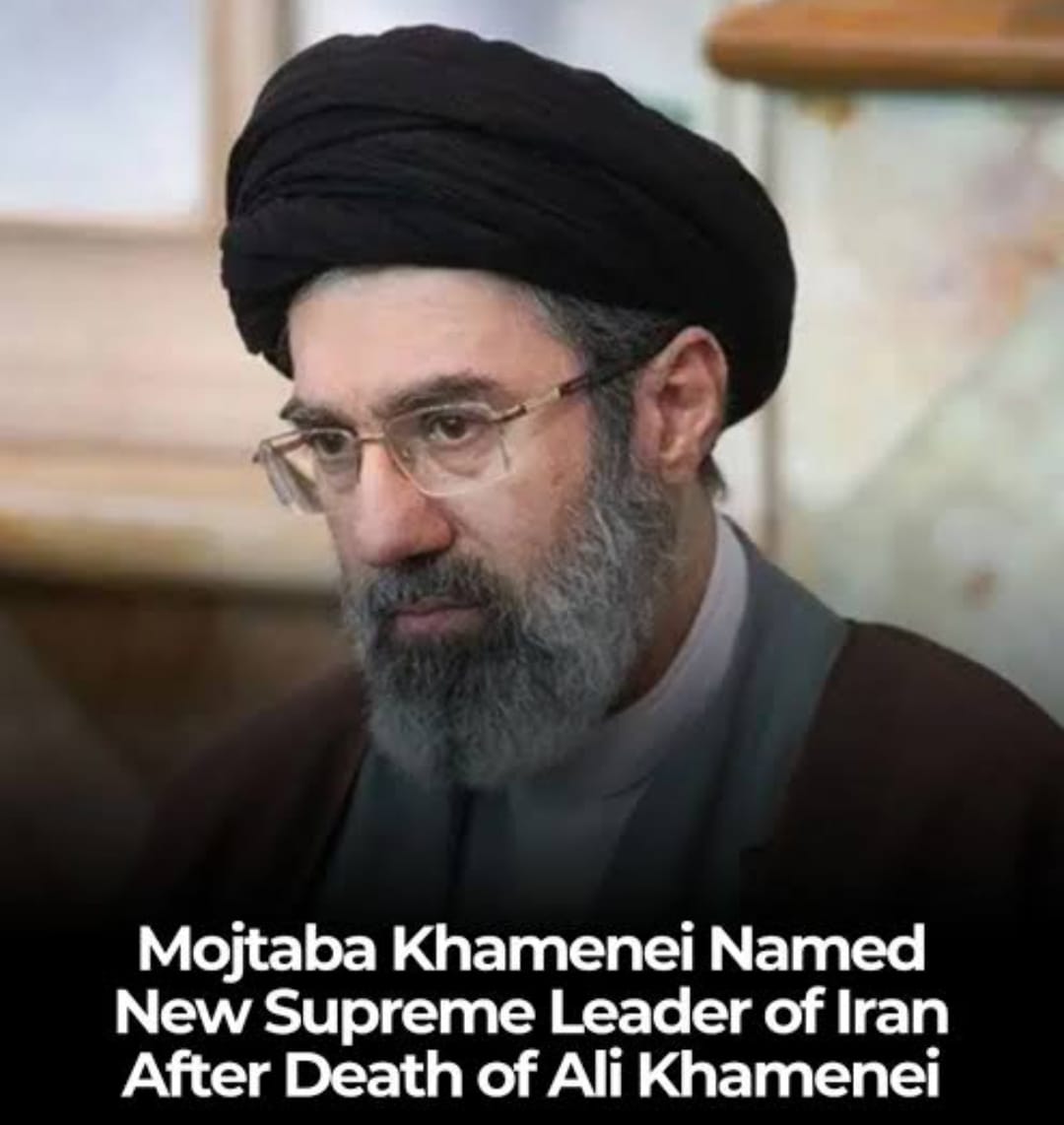
Mojtaba Khamenei, the second son of Ayatollah Ali Khamenei, who was killed on the first day of the war that the United States and Israel launched on Iran, has been selected as Iran’s new supreme leader, of the Islamic State of Iran.
The 56-year-old hardline cleric’s mother, wife, and one of his sisters were also killed in the air strike that killed his father, but the younger Khamenei was reportedly not present and has so far survived the intense bombing of Iran.
Meanwhile, Israel in its reaction to the appointment said that the new leader will be targeted as his agenda is terrorist in nature as he supports every terrorists agenda.
Iran’s Assembly of Experts – the 88-member clerical body that selects the country’s supreme leader – has called upon Iranians to maintain unity and pledge support to Mojtaba Khamenei.
In a statement circulated on state media on Sunday, the assembly said that Khamenei was chosen based on a “decisive vote”.
It urged all Iranians, “especially the elites and intellectuals of the seminaries and universities”, to “pledge allegiance to the leadership and maintain unity”.
Khamenei has never run for office or been subjected to a public vote, but has for decades been a highly influential figure in the inner circle of the previous supreme leader, cultivating deep ties to the paramilitary Islamic Revolutionary Guard Corps (IRGC).
In recent years, Khamenei had increasingly been touted as a top potential replacement for his father, who was president for nearly eight years and then held absolute power for 36 years, before being killed in attacks on his compound in Tehran on Saturday, February 28.
The younger Khamenei’s ascension, often classified as a gatekeeper to the father, is a clear sign that more hardline factions in Iran’s establishment retain power, and could indicate that the government has little desire to agree to a deal or negotiations in the short term.
Mojtaba Khamenei has never discussed the issue of succession publicly, a sensitive topic, considering that his ascension to the position of supreme leader would effectively create a dynasty reminiscent of the Pahlavi monarchy before the 1979 Islamic revolution.
Instead, Khamenei has largely kept a low profile, not giving public lectures, Friday sermons, or political addresses – to the point that many Iranians have not heard his voice, despite knowing for years that he was a star rising within the theocratic establishment
About The Author