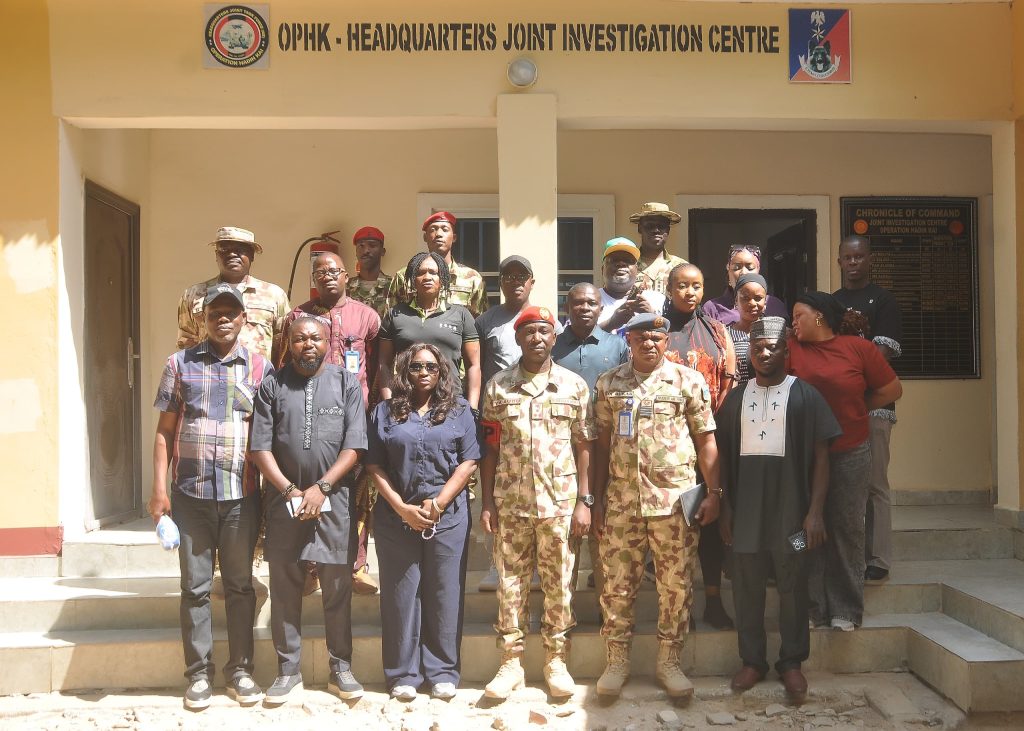
The Joint Investigation Centre (JIC), Giwa Barracks, under Operation HADIN KAI (OPHK) in the North East, has introduced vocational and entrepreneurial training programmes for arrested bandit suspects awaiting trial, as part of efforts to promote rehabilitation and humane detention practices.
The Commander of the Centre, Brigadier General Yusuf Audu, disclosed this on Wednesday, January 21, 2026, while conducting journalists on a facility tour during the Defence Media Operations assessment visit to the OPHK theatre of operations.
According to Brigadier General Audu, detainees at the Centre are being trained in various skills, including cap making, tailoring, soap production, fish farming and animal husbandry, among others. He noted that many of the suspects have shown keen interest in the empowerment programmes while awaiting prosecution by the Directorate of Public Prosecutions of the Federal Ministry of Justice.
He revealed that the Centre currently houses 2,102 suspects, including 68 females, while investigations have been concluded in 1,050 out of 2,170 cases processed so far. The facility also accommodates 31 children who could not be separated from their parents. The children, he said, are enrolled in a school established within the JIC.
The JIC Commander further highlighted the Centre’s strong collaboration with international organisations and development partners in the area of civil-military cooperation. These include the International Committee of the Red Cross (ICRC), United Nations Office on Drugs and Crime (UNODC), United Nations Children’s Fund (UNICEF), and the International Organization for Migration (IOM).
He disclosed that the UNODC constructed a modern evidence storage facility, donated computers, and supported capacity-building workshops on terrorism investigations. Similarly, the IOM established a fully equipped data centre for registration, screening and biometric documentation of suspects, while the ICRC provides healthcare services, including treatment for malnutrition and tuberculosis.

Brigadier General Audu emphasized that the JIC operates a human-rights-based approach supported by modern equipment and special investigation techniques. He added that the detention of suspects is conducted strictly in line with the law, with remand orders obtained from the Federal High Court.
He explained that cases and investigations are reviewed by a Complex Casework Group, which provides legal guidance on whether suspects should be prosecuted, rehabilitated, reintegrated, or referred for immigration-related actions, in line with established legal and humanitarian standards.
About The Author