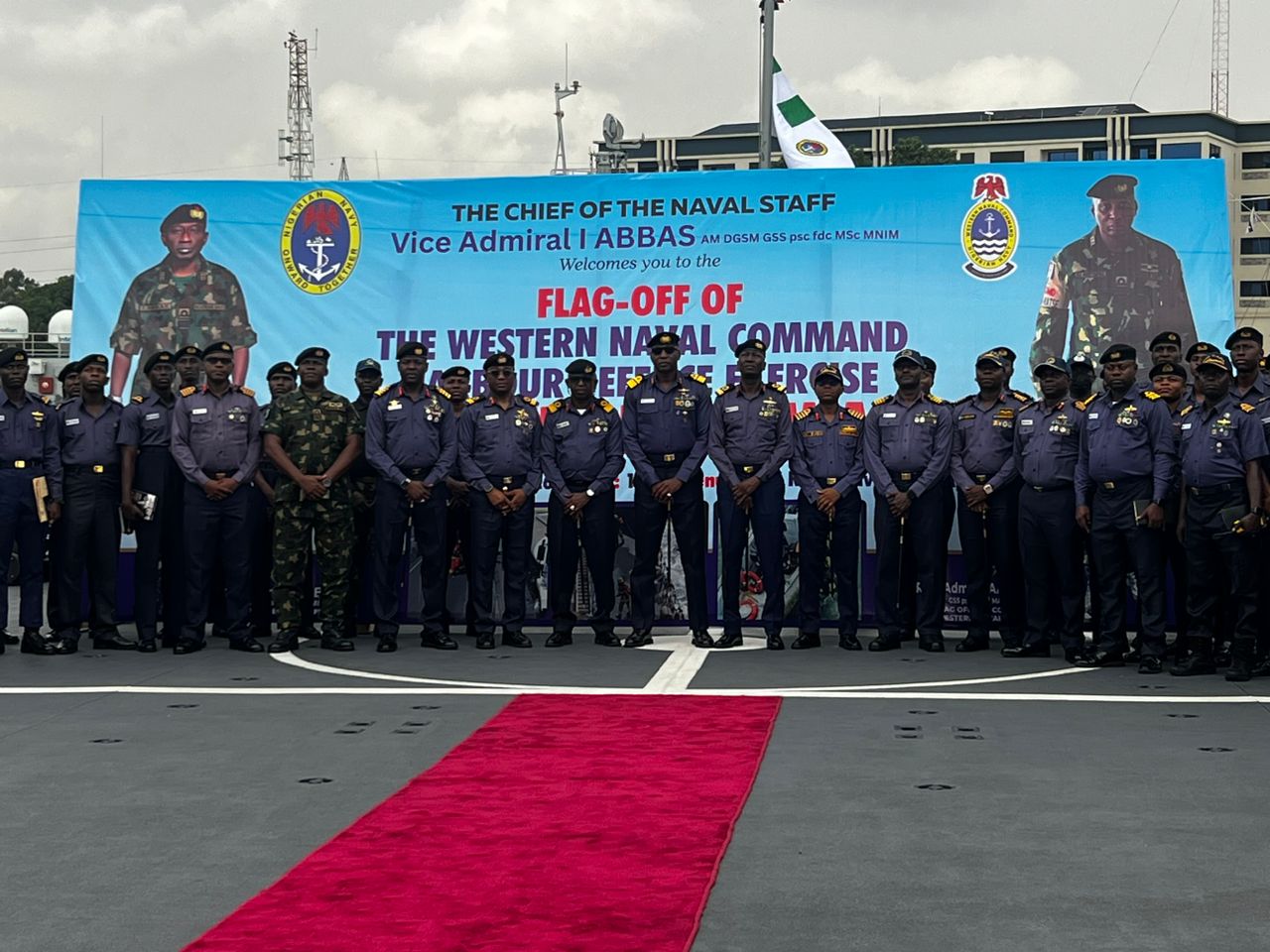
In a deliberate push to evaluate its operational preparedness and strengthening Nigeria’s maritime security architecture, the Nigerian Navy has commenced “Operation Awkward 2026,” in Lagos.
The harbour defence exercise hosted by the Western Naval Command (WNC), was flagged off onboard Nigerian Navy Ship (NNS) KADA in Apapa, Lagos, on Thursday, 19th February, 2026.
According to the Flag Officer Commanding (FOC), Rear Admiral Abdullahi Abubakar Mustapha, disclosed that the exercise is designed to assess the preparedness of personnel and equipment, identify operational gaps, and refine strategies, tactics, techniques and procedures required for the effective defence of Nigeria’s maritime domain.
He further noted that the operation is part of the Navy’s broader effort to maintain a highly professional force capable of safeguarding critical maritime assets and supporting national sovereignty.
According the FOC, Operation Awkward provides a realistic platform for evaluating the Navy’s response capabilities in real-life scenarios, particularly within harbour environments that house strategic infrastructure and economic assets.
Rear Admiral Mustapha noted that lessons drawn from the exercise would be used to recalibrate operational strategies, improve tactical coordination, and enhance overall readiness across the command.
He also pointed to the growing international interest in training with the Nigerian Navy, attributing it to the professionalism of its personnel and recent global rankings that place the service among the top 22 navies in the world.
Operation Awkward 2026 is focused on harbour defence operations within channels, terminals and adjoining maritime infrastructure under the command’s area of responsibility. The exercise includes coordinated boat operations by naval units from Apapa, Tarkwa Bay and Badagry, extending to the fairway buoy.
Also speaking, the Commander of NNS BEECROFT, Commodore Aiwuyor Adams-Aliu, said the exercise underscores the Navy’s commitment to continuous training and preparedness in an increasingly complex maritime environment.
He explained that the drills are intended to rehearse procedures, validate communication channels and reinforce the security framework protecting ships, installations and personnel within the harbour and adjoining waters.
According to him, sustained training during periods of relative calm remains critical to ensuring effective response during crises and to preserving lives, equipment and mission success.
About The Author